Denver screening criteria
Background
- Used to screen for vertebral and carotid artery dissection and/or injury after blunt head and neck trauma (BCVI - blunt cerebrovascular injury)[1][2]
- A CTA to evaluate for VAI should be obtained in those meeting the modified Denver Criteria
- BCVI has the highest association with cervical hyperextension and rotation, hyperflexion, or direct blunt force to head and neck[3]
- Most injuries are diagnosed after the development of symptoms secondary to central nervous system ischemia resulting in neurologic morbidity of up to 80% and associated mortality of up to 40%.[4]
Criteria
Denver screening criteria for blunt cerebrovascular injury
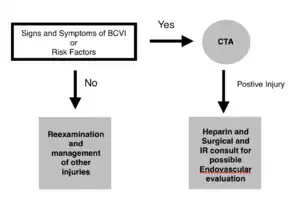
The Denver Screening Criteria are divided into risk factors and signs and symptoms
Signs and Symptoms
- Arterial hemorrhage
- Cervical bruit
- Expanding neck hematoma
- Focal neurologic deficit
- Neuro exam inconsistent with head CT
- Stroke on head CT
See Also
References
- ↑ Bromberg, William. et al. Blunt Cerebrovascular Injury Practice Management Guidelines: The Eastern Association for the Surgery of Trauma. J Trauma. 68 (2): 471-7, Feb 2010.
- ↑ Cothren CC, Moore EE, Biffl WL, et al. Anticoagulation is the gold standard therapy for blunt carotid injuries to reduce stroke rate. Arch Surg. 2004;139:540–545; discussion 545–546. PDF
- ↑ Biffl WL, Moore EE, Offner PJ, et al. Optimizing screening for blunt cerebrovascular injuries. Am J Surg. 1999;178:517–522.
- ↑ Davis JW, Holbrook TL, Hoyt DB, Mackersie RC, Field TO Jr, Shackford SR. Blunt carotid artery dissection: incidence, associated injuries, screening, and treatment. J Trauma. 1990;30:1514–1517
Category: