EBQ:Denver Screening Criteria
Background
- Used to screen for vertebral and carotid artery dissection and/or injury after blunt head and neck trauma (BCVI - blunt cerebrovascular injury)[1][2]
- A CTA to evaluate for VAI should be obtained in those meeting the modified Denver Criteria
- BCVI has the highest association with cervical hyperextension and rotation, hyperflexion, or direct blunt force to head and neck[3]
- Most injuries are diagnosed after the development of symptoms secondary to central nervous system ischemia resulting in neurologic morbidity of up to 80% and associated mortality of up to 40%.[4]
Clinical Question
- Can clinical criteria and injury profile and risk factors successfully identify patients at risk for BCVI?
Conclusion
Denver criteria can successfully identify trauma patients at risk for vascular injury.
- 5% of trauma patients were screened
- 18% of screened patients had a vascular injury
Denver screening criteria for blunt cerebrovascular injury
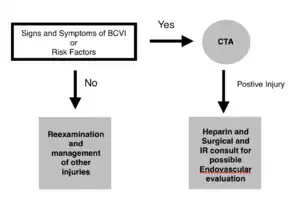
The Denver Screening Criteria are divided into risk factors and signs and symptoms
Signs and Symptoms
- Arterial hemorrhage
- Cervical bruit
- Expanding neck hematoma
- Focal neurologic deficit
- Neuro exam inconsistent with head CT
- Stroke on head CT
- Kerwin et al: Using the above criteria for both symptomatic and asymptomatic patients, found a 44% positive angiography rate in 1941 patients.[5]
- Fabian et al: Reported a drop in BCI-associated mortality from 24% to 13% after instituting a broad screening protocol.[6]
Major Points
- The Denver Screening Criteria identify trauma patients at risk for blunt cerebrovascular injury (BCVI)
- Screening 5% of all trauma patients using clinical criteria captured 18% with confirmed vascular injury
- Early identification of BCVI allows initiation of antithrombotic therapy to prevent devastating stroke
- Implementation of screening protocols has been associated with reduced BCVI-related mortality
Study Design
- Prospective, single-center observational study
- Denver Health Medical Center, Level I Trauma Center
- Screening criteria applied to all blunt trauma patients presenting to the ED
- Positive screening triggered 4-vessel cerebral angiography
Population
Inclusion Criteria
- All blunt trauma patients presenting to the trauma center
- Patients meeting one or more Denver screening criteria
Exclusion Criteria
- Penetrating trauma
- Patients who died before screening could be completed
Interventions
- No therapeutic intervention; this was a screening accuracy study
- Patients meeting Denver criteria underwent 4-vessel cerebral angiography
- Positive patients received antithrombotic therapy (heparin or antiplatelet agents)
Outcomes
- 5% of all trauma patients met screening criteria
- 18% of screened patients had confirmed vascular injury on angiography
- Kerwin et al validation: 44% positive angiography rate in 1,941 patients using liberalized criteria
- Fabian et al: BCVI-associated mortality decreased from 24% to 13% after instituting screening
Criticisms
- The Denver Criteria have not been externally validated in a large multicenter study
- CTA has largely replaced conventional angiography for screening, and the criteria were developed in the angiography era
- Sensitivity of the criteria is unknown; some BCVI may be missed in patients not meeting screening criteria
- Optimal antithrombotic treatment protocol for identified BCVI remains debated
- The Memphis criteria provide an alternative screening tool with similar variables
Funding
- None reported
Validation
- The Denver Criteria has not been externally validated
- The Memphis Criteria which includes many of the same criteria screened 3.9% of patients and found an incidence of 29% vascular injury in screened patients.
- Cervical Spine Fracture
- Neuro deficit not explained by brain imaging
- Horner's Syndrome
- Leforte 2 or 3 fracture
- Basilar Skull Fracture involving the carotid Canal
- Seatbelt Sign
- Neck Hematoma
- Hanging Mechanism
See Also
Sources
- ↑ Bromberg, William. et al. Blunt Cerebrovascular Injury Practice Management Guidelines: The Eastern Association for the Surgery of Trauma. J Trauma. 68 (2): 471-7, Feb 2010.
- ↑ Cothren CC, Moore EE, Biffl WL, et al. Anticoagulation is the gold standard therapy for blunt carotid injuries to reduce stroke rate. Arch Surg. 2004;139:540–545; discussion 545–546. PDF
- ↑ Biffl WL, Moore EE, Offner PJ, et al. Optimizing screening for blunt cerebrovascular injuries. Am J Surg. 1999;178:517–522.
- ↑ Davis JW, Holbrook TL, Hoyt DB, Mackersie RC, Field TO Jr, Shackford SR. Blunt carotid artery dissection: incidence, associated injuries, screening, and treatment. J Trauma. 1990;30:1514–1517
- ↑ Kerwin AJ, Bynoe RP, Murray J et al. Liberalized screening for blunt carotid and vertebral artery injuries is justified. J. Trauma 2001; 51: 308–14.
- ↑ Fabian TC, Patton JH, Croce MA et al. Blunt carotid injury: importance of early diagnosis and anticoagulant therapy. Ann. Surg.1996; 223: 513–25.