Strangulation
Background


- Strangulation
- Hanging, ligature, manual or postural strangulation
- Homicide, assault, suicide or execution
- Mechanism of death/injury [1]
- Spinal cord/brainstem injury
- Mechanical compression
- Bradycardia
Pathophysiology
- Upper C-spine fractures
- Judicial hanging, greater heights
- Jugular venous obstruction
- Cerebral congestion
- Loss of consciousness
- Arterial compression
- Cerebral ischemia
- Airway compression
- Carotid baroreceptor reflex
Clinical Features

- Facial petechiae
- Ecchymoses
- Airway
- Hoarseness
- Stridor
- Fracture of larynx, hyoid, thyroid cartilage
- Laryngeal edema
- Cardiopulmonary
- Neurologic
- Spinal cord trauma
- Hangman's fracture uncommon
- Neurogenic shock
- Cerebral anoxia
- Cerebral edema
- Delayed dementia, amnesia, psychosis
Differential Diagnosis
Neck Trauma
- Penetrating neck trauma
- Blunt neck trauma
- Cervical injury
- Neurogenic shock
- Spinal cord injury
Evaluation
- CBC
- Chem 10
- PT/PTT
- Type and screen
- Lactate
- VBG/ABG
- EtOH, Utox
- CT brain
- CT cervical spine
- CTA neck criteria from Taming of the Sru Grand Rounds [2]directly quoted below:
- Guidelines for imaging: GCS<8, audible neck bruit, expanding neck hematoma, focal neurologic deficit (including TIAs, Horner’s syndrome, vertebrobasilar syndrome), arterial bleeding from nose, mouth, neck
- OR consider adding on if high C spine fracture, cervical vertebral body or fracture through foramen transversarium, subluxation or ligamentous injury at any level, significant thoracic/cardiac blunt force trauma, LeFort II or III fractures, skull base fracture, diffuse axonal injury
- CTA neck AND head (can miss top of carotids with just CTA neck)
- Guidelines for imaging: GCS<8, audible neck bruit, expanding neck hematoma, focal neurologic deficit (including TIAs, Horner’s syndrome, vertebrobasilar syndrome), arterial bleeding from nose, mouth, neck
- CXR
Denver screening criteria for blunt cerebrovascular injury
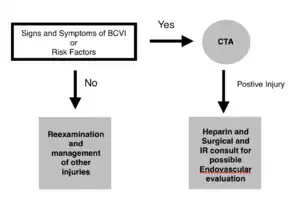
The Denver Screening Criteria are divided into risk factors and signs and symptoms
Signs and Symptoms
- Arterial hemorrhage
- Cervical bruit
- Expanding neck hematoma
- Focal neurologic deficit
- Neuro exam inconsistent with head CT
- Stroke on head CT
Management
- ATLS
- Secure airway if indicated
- Stridor/hoarseness suggests upper airway obstruction
- Cervical spine immobilization
- Cardiac monitoring
- Antibiotics if aspiration present
- PEEP for hypoxia
- Levophed for neurogenic shock
Disposition
- Observation warranted if awake, alert, no stridor
- ICU
- Psychiatric assessment
See Also
References
- ↑ Iserson, K. V. (1984) ‘Strangulation: A review of ligature, manual, and postural neck compression injuries’, Annals of Emergency Medicine, 13(3), pp. 179–185.
- ↑ Taming of the Sru Grand Rounds Recap 11.6.19 accessed 11/25/2019. Copy permission given by CC BY-NC-SA 4.0 license Taming of the Sru Website